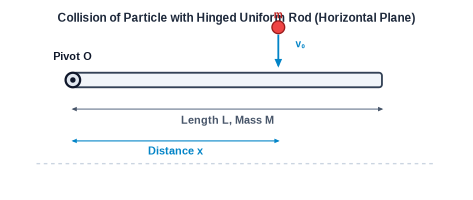
A uniform thin rod of mass $M$ and length $L$ lies on a smooth horizontal table and is pivoted about a frictionless vertical axis through its end $O$. A particle of mass $m$ moving horizontally with speed $v_0$ perpendicular to the rod strikes it at a distance $x$ from the pivot $O$ and sticks to it. If the impulse exerted by the pivot $O$ on the rod during the impact is identically zero, the value of $x$ (center of percussion) must be:
👆 Click any option to test your answer instantly (Green = Correct, Red = Wrong):
View Official Answer & Step-by-Step Solution Instant Verification
CORRECT ANSWER
Option (A): A) $\frac{2}{3}L$
Step-by-Step Mathematical Derivation:
1. Let $J_{\text{ext}}$ be the impulsive reaction at the pivot $O$. For $J_{\text{ext}} = 0$, the linear momentum delivered by the collision equals the change in linear momentum of the rod center of mass:\n$\Delta P = J = m v_0 - m v' = M v_{cm} = M\left(\frac{L}{2}\omega\right)$.\n\n2. Conserving angular momentum about the pivot $O$:\n$J x = I_O \omega = \left(\frac{1}{3}ML^2\right)\omega$.\n\n3. Dividing the angular momentum equation by the linear impulse equation:\n$\frac{J x}{J} = \frac{\frac{1}{3}ML^2 \omega}{M\left(\frac{L}{2}\omega\right)} \implies x = \frac{\frac{1}{3}ML^2}{\frac{1}{2}ML} = \frac{2}{3}L$.\n\nHence, striking at $x = \frac{2}{3}L$ produces zero impulsive reaction at the hinge.