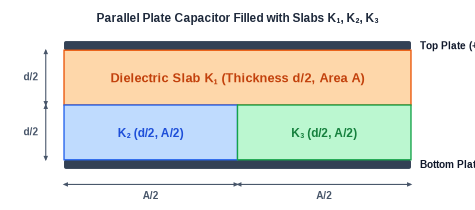
A parallel plate capacitor with plate area $A$ and plate separation $d$ has vacuum capacitance $C_0 = \frac{\varepsilon_0 A}{d}$. The space between the plates is filled with three dielectric slabs as shown in the diagram: the top layer of thickness $d/2$ has dielectric constant $K_1$ across full area $A$; the bottom layer of thickness $d/2$ is divided equally into two regions of area $A/2$ each, filled with slabs of dielectric constants $K_2$ and $K_3$. The equivalent capacitance $C$ of the system is:
👆 Click any option to test your answer instantly (Green = Correct, Red = Wrong):
View Official Answer & Step-by-Step Solution Instant Verification
CORRECT ANSWER
Option (A): A) $\frac{2\varepsilon_0 A}{d} \left( \frac{K_1(K_2 + K_3)}{2K_1 + K_2 + K_3} \right)$
Step-by-Step Mathematical Derivation:
1. The bottom layer consists of two dielectric regions in parallel:\n$C_2 = \frac{K_2 \varepsilon_0 (A/2)}{d/2} = \frac{K_2 \varepsilon_0 A}{d}$\n$C_3 = \frac{K_3 \varepsilon_0 (A/2)}{d/2} = \frac{K_3 \varepsilon_0 A}{d}$\nEquivalent capacitance of the bottom layer: $C_{\text{bot}} = C_2 + C_3 = \frac{\varepsilon_0 A}{d}(K_2 + K_3)$.\n\n2. The top layer of thickness $d/2$ and area $A$ has capacitance:\n$C_1 = \frac{K_1 \varepsilon_0 A}{d/2} = \frac{2 K_1 \varepsilon_0 A}{d}$.\n\n3. The top layer $C_1$ is in series with the combination $C_{\text{bot}}$:\n$$\frac{1}{C} = \frac{1}{C_1} + \frac{1}{C_{\text{bot}}} = \frac{d}{2K_1 \varepsilon_0 A} + \frac{d}{(K_2 + K_3)\varepsilon_0 A} = \frac{d}{\varepsilon_0 A} \left[ \frac{K_2 + K_3 + 2K_1}{2K_1(K_2 + K_3)} \right]$$\n\n4. Inverting gives:\n$$C = \frac{2\varepsilon_0 A}{d} \left( \frac{K_1(K_2 + K_3)}{2K_1 + K_2 + K_3} \right)$$\nHence Option A is correct.