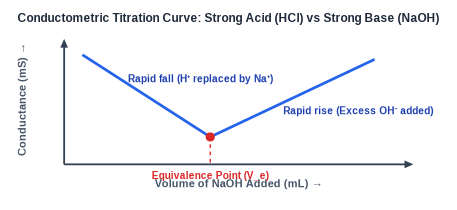
The conductometric titration curve shown represents the titration of an aqueous solution of strong acid ($\text{HCl}$) with an aqueous solution of strong base ($\text{NaOH}$). Which statement correctly explains why the electrolytic conductance initially drops sharply to a minimum at the equivalence point $V_e$, and then rises steeply after $V_e$?
👆 Click any option to test your answer instantly (Green = Correct, Red = Wrong):
View Official Answer & Step-by-Step Solution Instant Verification
CORRECT ANSWER
Option (A): A) Highly mobile $\text{H}^+$ ions are consumed and replaced by slower $\text{Na}^+$ ions up to $V_e$; after $V_e$, excess highly mobile $\text{OH}^-$ ions accumulate.
Step-by-Step Mathematical Derivation:
1. In aqueous solution, the limiting ionic molar conductivities are:\n- $\lambda^\circ(\text{H}^+) \approx 349.6\text{ S}\cdot\text{cm}^2\cdot\text{mol}^{-1}$ (exceptionally high due to Grotthuss proton-hopping mechanism)\n- $\lambda^\circ(\text{OH}^-) \approx 198.0\text{ S}\cdot\text{cm}^2\cdot\text{mol}^{-1}$ (second highest)\n- $\lambda^\circ(\text{Na}^+) \approx 50.1\text{ S}\cdot\text{cm}^2\cdot\text{mol}^{-1}$\n\n2. Before equivalence point: $\text{H}^+ + \text{Cl}^- + \text{Na}^+ + \text{OH}^- \to \text{Na}^+ + \text{Cl}^- + \text{H}_2\text{O}$. Each added $\text{NaOH}$ replaces a fast-moving $\text{H}^+$ ion with a slower $\text{Na}^+$ ion, causing conductance to decrease steeply.\n\n3. After equivalence point: All $\text{H}^+$ ions have been neutralized. Further addition of $\text{NaOH}$ introduces free $\text{Na}^+$ and highly mobile $\text{OH}^-$ ions into solution without removal of any existing ions, causing conductance to rise steeply.\nHence Option A is correct.